
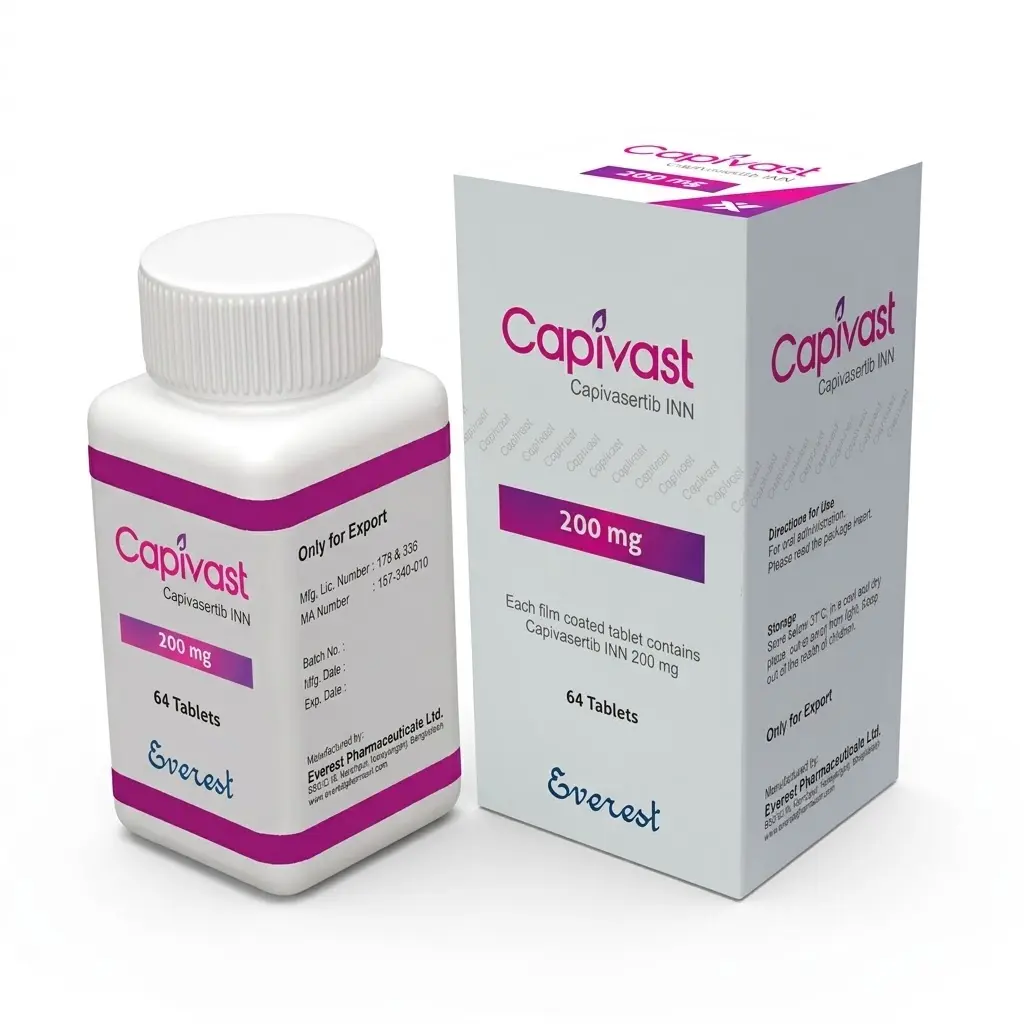
Capivast Tablets — Capivasertib 200 mg (64 Tabs) Everest
Capivast 200 mg (Capivasertib) is an innovative targeted therapy and a potent selective inhibitor of all three isoforms of the serine/threonine kinase AKT (AKT1/2/3). It is a generic equivalent to Truqap. The drug works by blocking the PI3K/AKT signaling pathway, which is frequently mutated in cancer cells, driving tumor growth and survival.
Manufacturer: Everest Pharmaceuticals (Bangladesh). Capivast is primarily used in combination therapy to overcome resistance to endocrine treatments.
Key Features:
- ✅ Pan-AKT Inhibition: Effectively inhibits AKT1, AKT2, and AKT3, preventing tumor adaptation.
- ✅ Biomarker Driven: Highly effective for patients with specific genetic alterations (PIK3CA, AKT1, or PTEN).
- ✅ Synergistic Action: Enhances the efficacy of fulvestrant, significantly extending progression-free survival.
Prescribed by oncologists for the treatment of adult patients with:
- 🔹 Breast Cancer: Hormone receptor (HR)-positive, human epidermal growth factor receptor 2 (HER2)-negative locally advanced or metastatic breast cancer with one or more PIK3CA/AKT1/PTEN alterations.
- Used in combination with fulvestrant following progression on endocrine-based regimens.
Sales Unit: Bottle containing 64 film-coated tablets (200 mg strength).
⚠️ APPLICATION INSTRUCTIONS:
- Standard Dosage: 400 mg (two 200 mg tablets) taken orally twice daily (approximately 12 hours apart).
- Schedule: Take for 4 consecutive days, followed by 3 days off. This weekly cycle is repeated.
- Administration: Swallow tablets whole with water, with or without food. Do not chew, crush, or split.
- ✋ Missed Dose: If a dose is missed by more than 4 hours, skip it. Take the next dose at the scheduled time.
- ⛔ Pregnancy & Breastfeeding: Contraindicated due to potential fetal harm.
- Severe hypersensitivity to Capivasertib.
- Pediatric patients (under 18 years).
- Severe hepatic impairment requires caution.
Treatment requires monitoring of blood glucose levels and skin condition:
- ⚠️ Hyperglycemia: High blood sugar is common. Regular glucose monitoring is essential.
- 🤢 Gastrointestinal: Diarrhea (very common), nausea, vomiting, stomatitis (mouth sores).
- 🔴 Dermatologic: Rash, cutaneous adverse reactions (requires monitoring).
- 🩸 Labs: Decreased lymphocytes and hemoglobin.
What Customers Say
No reviews yet
Your review can be the first!