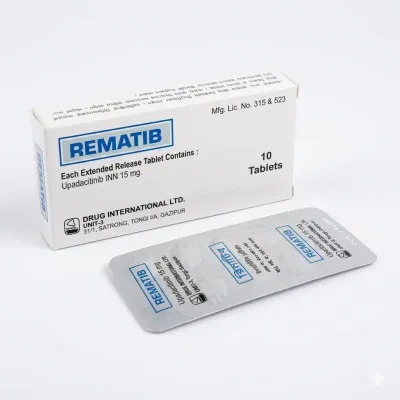
Upadacitinib: Selective JAK1 Inhibitor for Autoimmune Disease
Upadacitinib is a selective, reversible Janus kinase 1 (JAK1) inhibitor used for the treatment of several chronic inflammatory and autoimmune conditions. By preferentially inhibiting JAK1, the drug suppresses signaling pathways of pro-inflammatory cytokines (interleukins, interferons), while exerting less effect on JAK2 and JAK3, thereby reducing the risk of certain side effects.
Upadacitinib is taken orally and provides sustained control of inflammation across various diseases. On Unifarm, you can find generic versions of medications (such as Rinvoq) containing this active ingredient.

Indications
- Rheumatoid Arthritis (RA): Treatment of adults with moderately to severely active rheumatoid arthritis who have had an inadequate response or intolerance to methotrexate.
- Psoriatic Arthritis (PsA): Treatment of adults with active psoriatic arthritis who have had an inadequate response or intolerance to one or more DMARDs.
- Atopic Dermatitis (AD): Treatment of adults and adolescents (≥12 years) with moderate-to-severe atopic dermatitis whose disease is not adequately controlled with systemic therapies or when those therapies are not advisable.
- Ulcerative Colitis (UC): Treatment of adults with moderately to severely active ulcerative colitis who have had an inadequate response, loss of response, or intolerance to prior therapy.
- Crohn's Disease: Treatment of adults with moderately to severely active Crohn's disease who have had an inadequate response or intolerance to prior therapy.
- Ankylosing Spondylitis (AS): Treatment of adults with active ankylosing spondylitis who have had an inadequate response to conventional therapy.
Dosage and administration
Available as extended-release tablets for oral administration.
Standard Regimens:
- Rheumatoid Arthritis: 15 mg once daily.
- Psoriatic Arthritis: 15 mg once daily.
- Ankylosing Spondylitis: 15 mg once daily.
- Atopic Dermatitis (adults): 15 mg or 30 mg once daily depending on severity; adolescents (12–17 years) — 15 mg once daily.
- Ulcerative Colitis: Induction — 45 mg once daily for 8 weeks; maintenance — 15 mg or 30 mg once daily.
- Crohn's Disease: Induction — 45 mg once daily for 12 weeks; maintenance — 15 mg or 30 mg once daily.
Administration: Swallow tablets whole; do not split, crush, or chew. May be taken with or without food. Dose reduction is required when co-administered with strong CYP3A4 inhibitors (e.g., ketoconazole).
- Hypersensitivity to upadacitinib or any component of the product.
- Active serious infections, including tuberculosis (screening for latent TB required before initiation).
- Pregnancy and breastfeeding (teratogenic potential).
- Severe hepatic impairment (Child-Pugh C).
- Absolute lymphocyte count <500 cells/mm³, absolute neutrophil count <1000 cells/mm³, or hemoglobin <8 g/dL (do not initiate therapy).
- Concomitant use with other JAK inhibitors, biologic DMARDs, or strong immunosuppressants (azathioprine, cyclosporine).
Upadacitinib therapy requires regular monitoring of blood counts, hepatic function, and lipid profiles. Common adverse reactions include:
- Infections: Upper respiratory tract infections, nasopharyngitis, bronchitis; serious infections (pneumonia, herpes zoster, opportunistic infections).
- Hematologic: Neutropenia, lymphopenia, anemia.
- Hepatic: Elevated transaminases (ALT, AST).
- Metabolic: Hypercholesterolemia, elevated creatine phosphokinase (CPK).
- Gastrointestinal: Nausea, abdominal pain, gastrointestinal perforation (rare).
- Dermatologic: Acne (especially common in younger patients), folliculitis.
- Thromboembolic events: Deep vein thrombosis, pulmonary embolism (increased risk, especially with risk factors).
- Malignancies: Increased risk of lymphoma and other malignancies (as with other JAK inhibitors).
- General: Headache, fatigue, pyrexia.