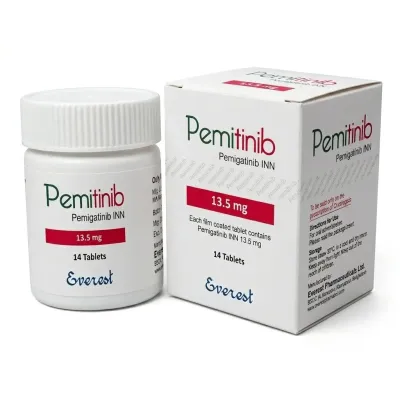
Pemigatinib (Pemazyre): Bile Duct Cancer & FGFR2 Fusion
Pemigatinib represents a breakthrough in treating cholangiocarcinoma (bile duct cancer). Before its approval, patients with this rare aggressive tumor had limited options. It works as a precision inhibitor targeting a specific genetic error known as FGFR2 fusion or rearrangement.
Think of the FGFR2 receptor as a "growth switch" that gets stuck in the "ON" position inside cancer cells. Pemigatinib (Pemazyre) locates this broken switch and forcibly turns it "OFF." Deprived of growth signals, the tumor stops spreading and begins to shrink.
This oral therapy offers a new lifeline for patients with advanced disease where surgery is not an option and chemotherapy has failed.

Indications
- Cholangiocarcinoma: Treatment of adults with previously treated, unresectable locally advanced or metastatic bile duct cancer.
- Crucial Requirement: Effective only in patients with a confirmed FGFR2 fusion or rearrangement. A genetic test is mandatory before starting therapy to ensure the drug targets the right mutation.
- Myeloid/Lymphoid Neoplasms: Rare blood cancers with FGFR1 rearrangement.
Dosage and administration
Therapy follows a specific cycle to balance efficacy and tolerability.
- The 21-Day Cycle:
- Days 1–14 (ON): Take one tablet (usually 13.5 mg) once daily.
- Days 15–21 (OFF): A 7-day rest period with no medication.
- Instructions: Take at the same time every day with or without food. Swallow whole.
- Missed Dose: If you miss a dose by more than 4 hours, skip it and resume the schedule the next day. Do not take extra tablets.
- Pregnancy: Pemigatinib can cause fetal harm. Effective contraception is non-negotiable.
- Concomitant use of St. John's Wort (it renders the drug ineffective).
- Severe renal or hepatic impairment.
- History of serious eye disorders (retinal detachment).
Pemigatinib has unique side effects due to its mechanism of action.
- Hyperphosphatemia (Very Common): High phosphate levels in the blood. This actually shows the drug is working. You may need a low-phosphate diet or phosphate binders.
- Eyes: Dry eyes, blurred vision. Rarely, retinal detachment. Report any vision changes immediately.
- Nails & Skin: Nail toxicity (separation, brittleness), hair loss, dry skin.
- Digestive: Taste changes (dysgeusia), nausea, diarrhea.